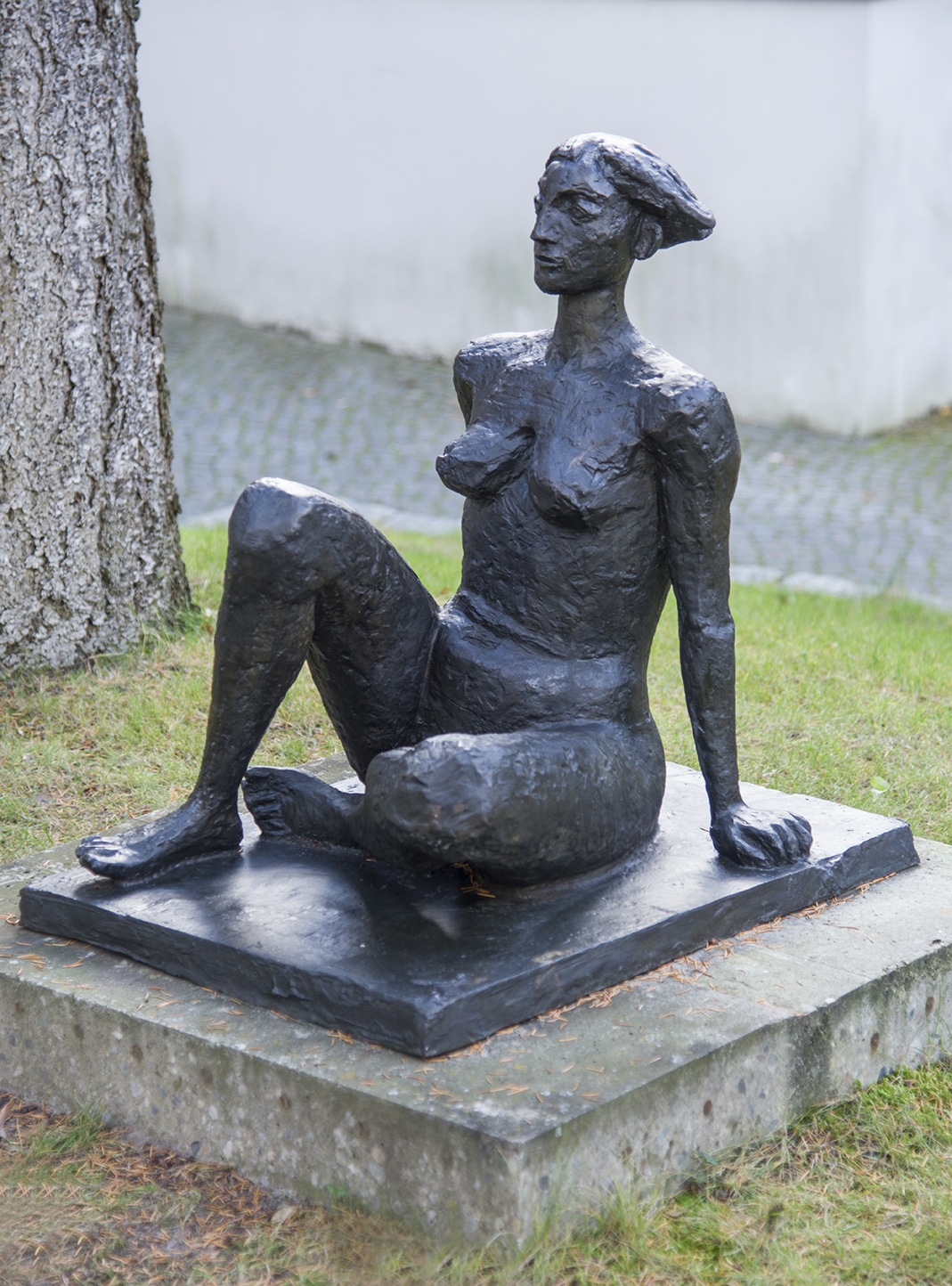
Jenny Mucchi-Wiegmann
1895 Berlin – 1969 Berlin
Mucchi-Wiegmann was one of the leading female sculptors on the Berlin art scene of the 1920s. After training under Lovis Corinth and August Kraus, she studied wood sculpture under Hans Peratoner at the Berlin Academy of Fine Arts from 1919 to 1923. During the 1920s, she developed her own distinctive, powerful formal language there, combining realism with archaic simplification. Study and working visits took her to Rome, Hagen, Spain and the south of France; in Hagen, she created a relief for the new Franciscan Church in 1926–27. From 1928, she was a member of the Association of Berlin Women Artists and regularly took part in its exhibitions.
From 1930, Mucchi-Wiegmann worked as a freelance sculptor in Berlin. She spent the years 1931–33 in Paris before moving to Milan in 1934 with her husband, the painter Gabriele Mucchi. There she continued her sculptural work and increasingly turned her attention to social and political themes. Her body of work includes nudes, reliefs, portrait busts and works for public spaces. Characteristic features include a focused, body-oriented formal language and the combination of realistic representation with archaic elements.