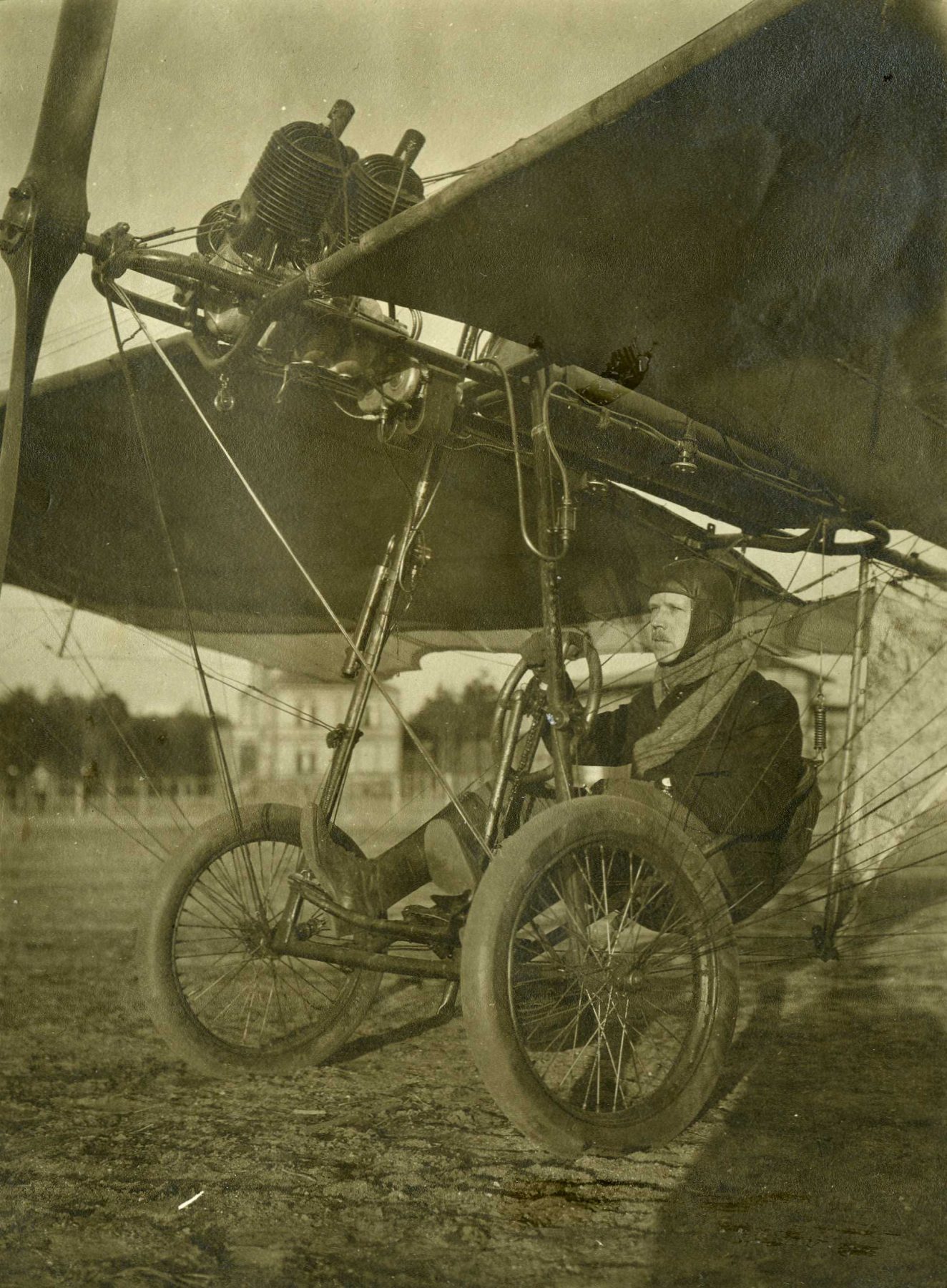
Georg Kolbe als Flugschüler, 1915, Flugplatz Bork bei Beelitz, Foto: Privatbesitz
Georg Kolbe and the First World War
14/09/2014–16/11/2014
Before the extensive renovation work at the Georg Kolbe Museum begins in November 2014 and the museum has to close for six months, there will be another opportunity to visit the museum. In addition to a comprehensive overview of the collection, the focus will be on Georg Kolbe’s sculptural work during the First World War to mark the outbreak of war 100 years ago.
Georg Kolbe and the First World War
The exhibition uses documents, letters, historical photographs and sketches to show the sculptor’s work during the First World War and his reactions to the outbreak of war. It is part of a series of exhibitions by various museums dealing with this topic under the title ‘Sculptors see the First World War’, accompanied by a joint catalogue with texts on Ernst Barlach, Gerhard Marcks and Edwin Scharff, among others.
In November 1914, the sculptor Georg Kolbe (1877-1947) wrote to a friend that he had begun pilot training in order to take an active part in the war effort. However, he was not called up at first. It was not until 1917 that Kolbe was called up for military service, but he was spared any frontline missions. He was transferred to Constantinople in Turkey, where he realised a two-figure group based on earlier monument designs by the artist. These and other projects, some of which were not realised, show how difficult it was for the young sculptor at the time to subordinate his sculptural theme – the ideal human nude – to a political statement. He himself wrote in response to a survey in 1915 ‘How do we design the monuments to our fallen heroes?’: ‘Suppress the pompous, boastful, because a Völkerschlacht-Bismarck style of bombing will appear pretentious. The well-known German term ‘colossal’ must not be used. Then a lot will be saved.’
Collection exhibition
Georg Kolbe’s iconic figure ‘Morning’, made famous by its installation in the water basin of Mies van der Rohe’s Barcelona Pavilion, will also be on display, as will its counterpart ‘Night’ from 1926 – a cast of which can be seen in the atrium of Hans Poelzig’s Haus des Rundfunks. Georg Kolbe’s dancing, animated nude figures are in a quiet dialogue with modern architecture, which reached an international peak in the 1920s, spurred on not least by the stylistic innovations of the Bauhaus. Georg Kolbe’s studio building from 1928/29 reflects this enthusiasm for New Building. To this day, the clear layout radiates the light spirit of modernism. Complex relationships between interior and exterior create spaces of lucid beauty and human-centred proportions. Georg Kolbe’s life theme was the nude human being. His figurative nude sculptures are dedicated to an inner harmony of body and spirit, which the artist is able to capture in sometimes expressive and very exciting gestures. In various phases of his work, he continually found new formulations that penetrated to the essentials through formal reduction, thereby establishing modern sculpture in Germany.