The Story of the Dancer’s Fountain
The Story of the Dancer’s Fountain
1920s
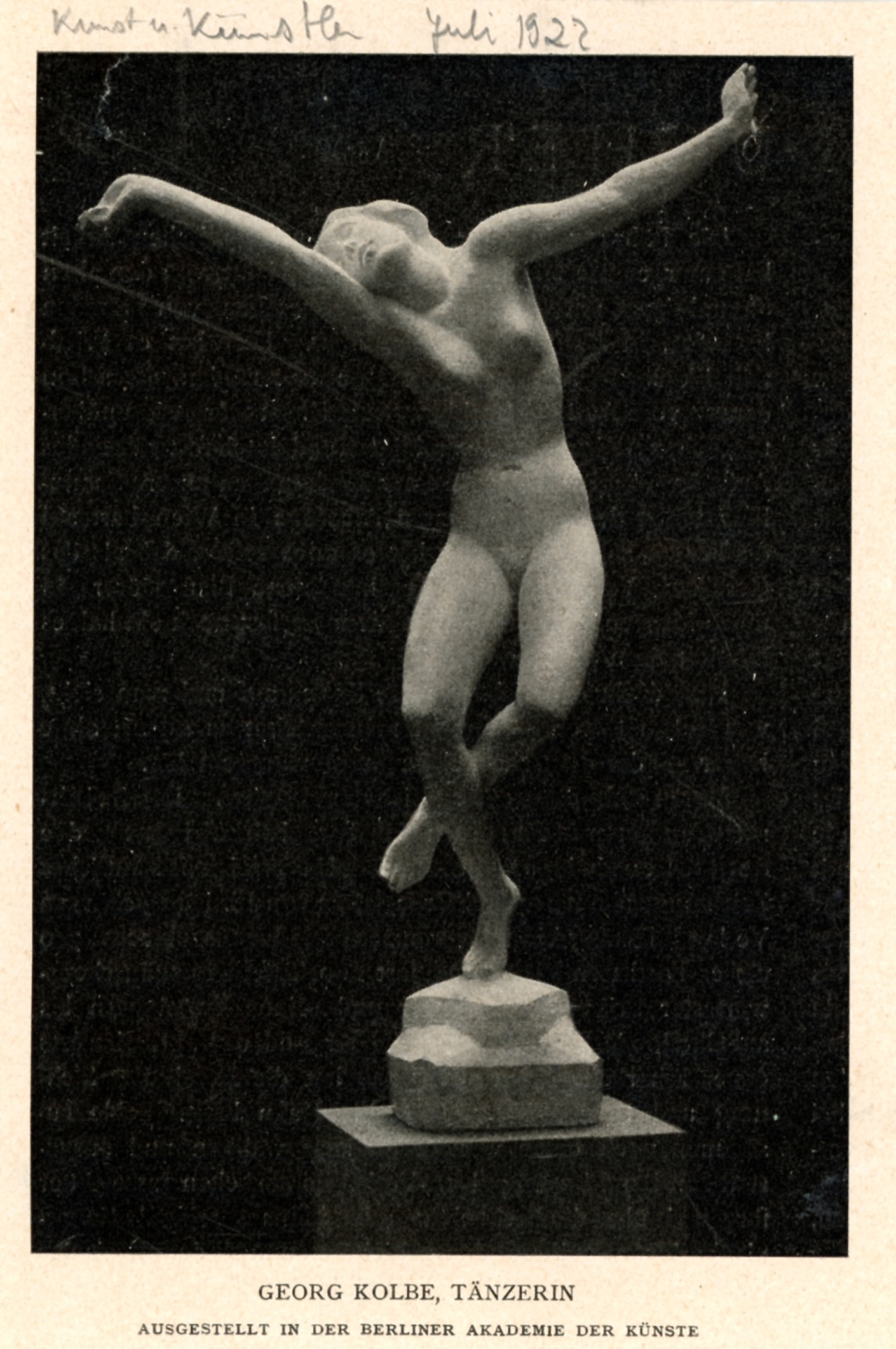
In the early 1920s, Georg Kolbe was able to bring to life a long-cherished idea that he had explored in earlier sketches and sculptural models: a fountain featuring crouching figures supporting a basin, crowned by a female figure. As part of this project, he first created several smaller-than-life-size sculptures of dancing women, balancing on one leg with outstretched arms, emerging from a flower-like form. In contrast to his clothed Javanese Dancer , Kolbe also designed the Fountain Dancer as a life-size figure, which was exhibited as a plaster model at the spring exhibition of the Akademie der Künste in Berlin in 1922 (Fig. 1) and then remained in his studio at the time in Berlin-Tiergarten.
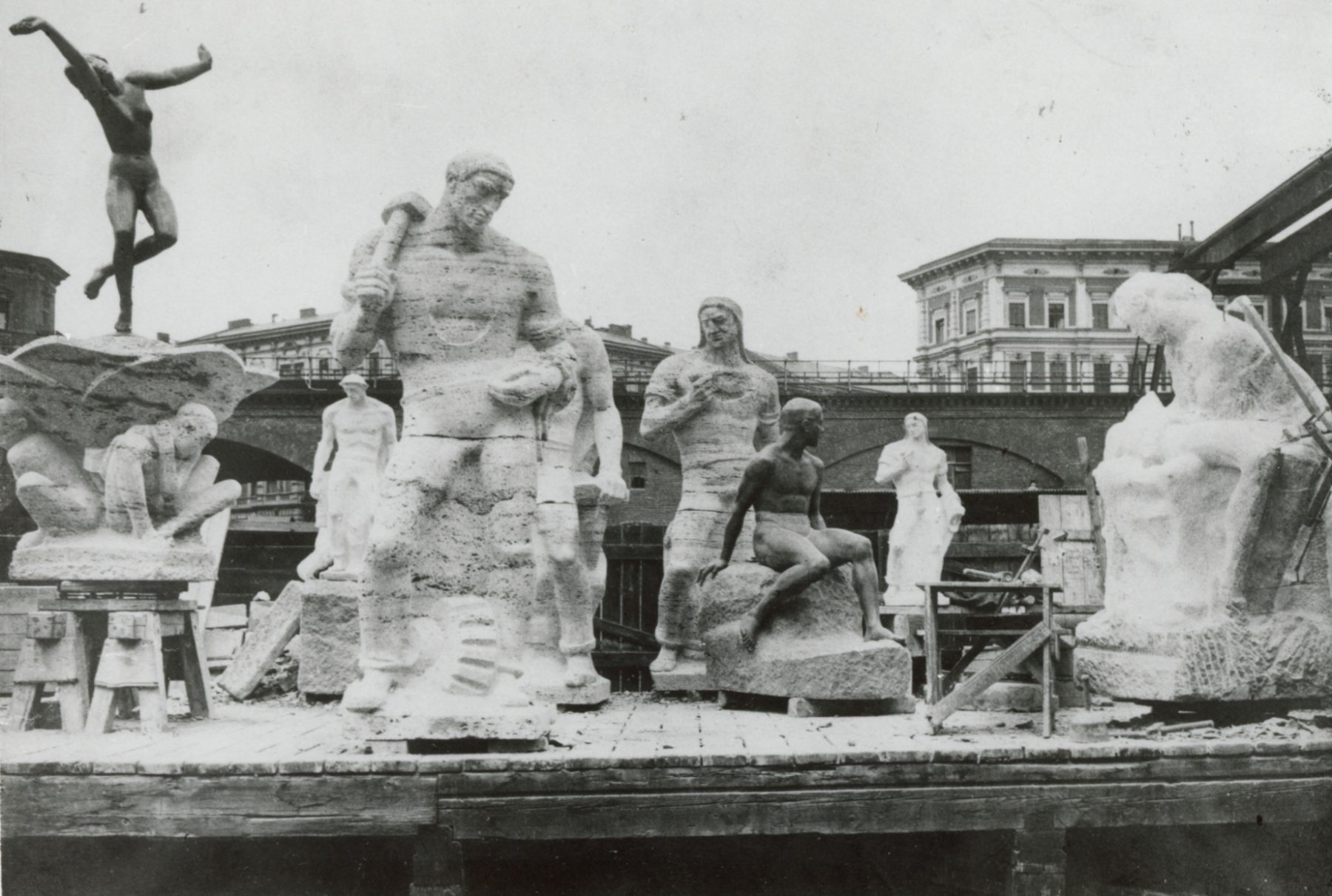
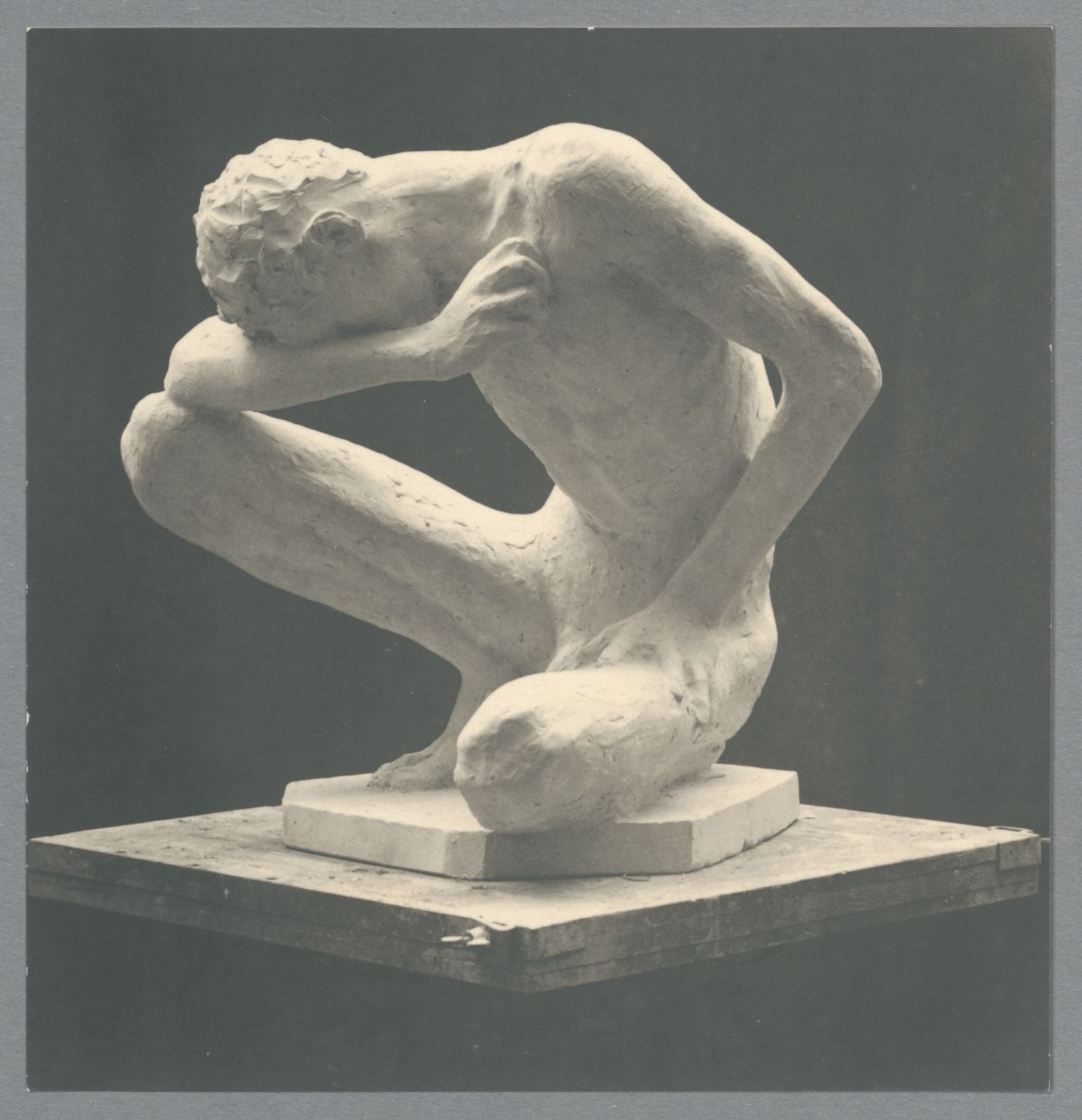
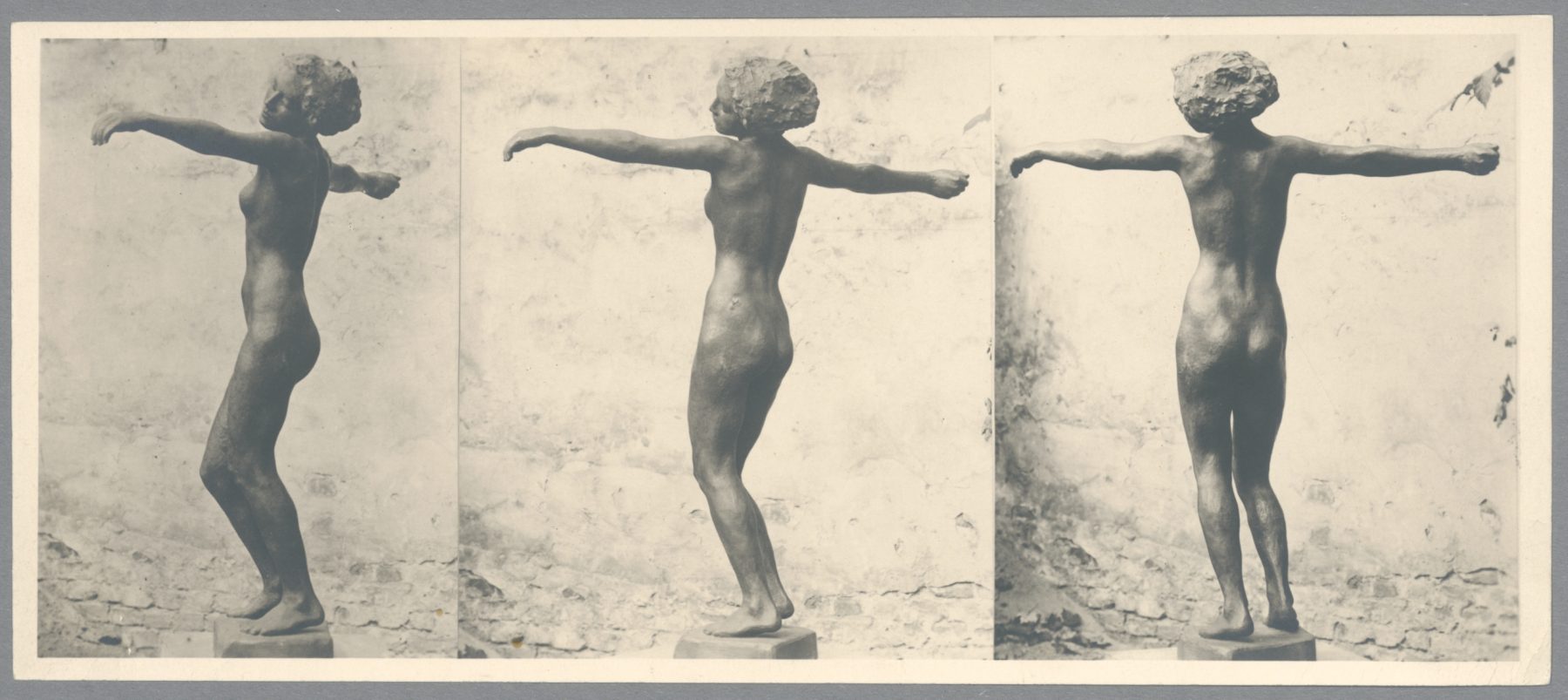
Kolbe received two commissions for the Fountain Dancer following the exhibition, both of which were cast later that year at the Hermann Noack Art Foundry in Berlin-Friedenau. One of the bronze sculptures, mounted on a stone pedestal, was placed in the garden of a villa in Cologne, while Kolbe integrated the second casting into a larger multi-part fountain. The fountain basin, the crouching male figures, and the limestone blossom-shaped bowl were crafted at a stonemasonry workshop in Berlin-Moabit (Fig. 2). For the Dancer’s Fountain, Kolbe combined and modified two significant figures from his early work before World War I. The three crouching supporting figures are reminiscent of his 1912 sculpture Crouching Somali (Fig. 3), while the Fountain Dancer mirrors the size and movement of his renowned 1911/12 Dancer, now part of the collection of the Nationalgalerie in Berlin (Fig. 4).
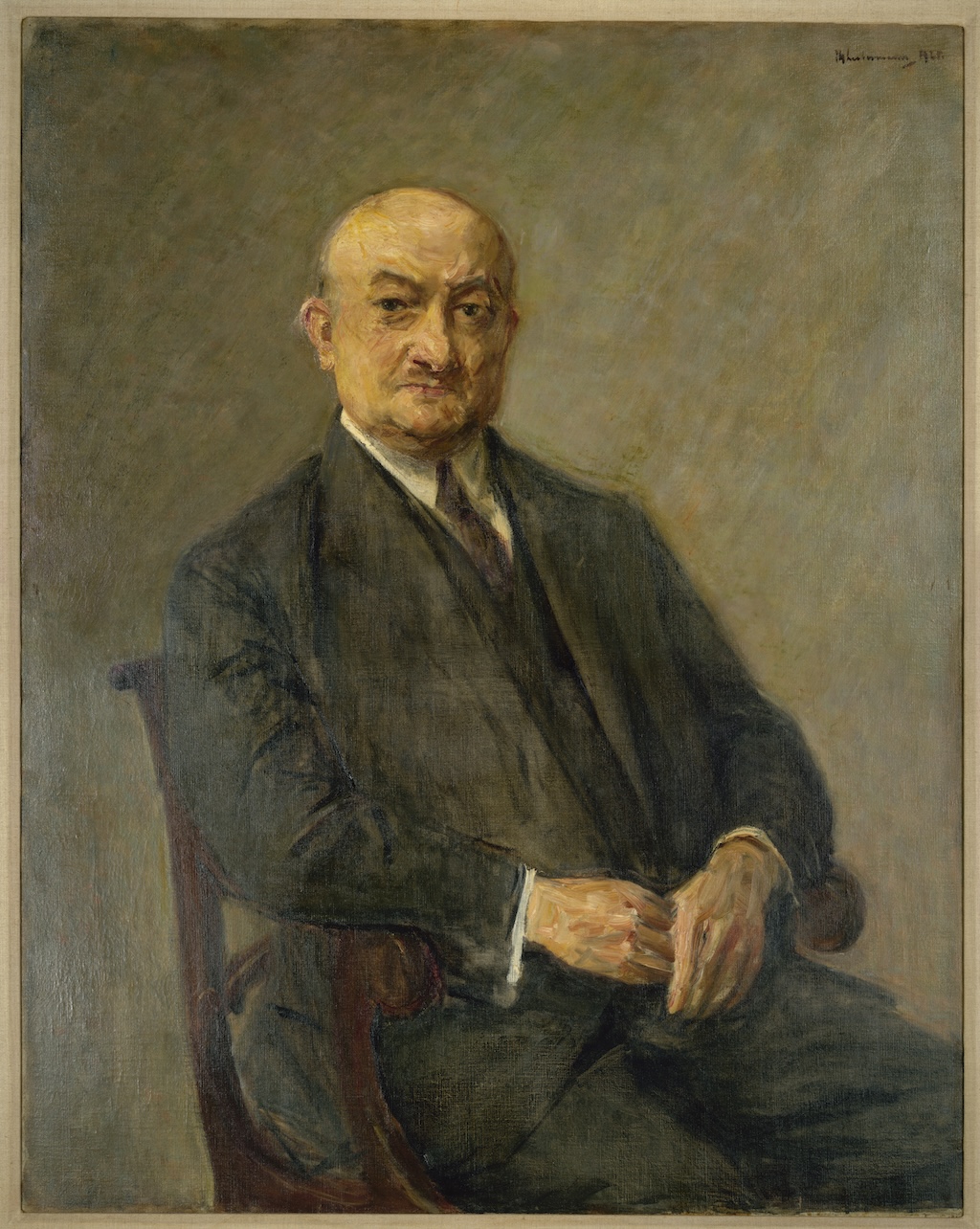
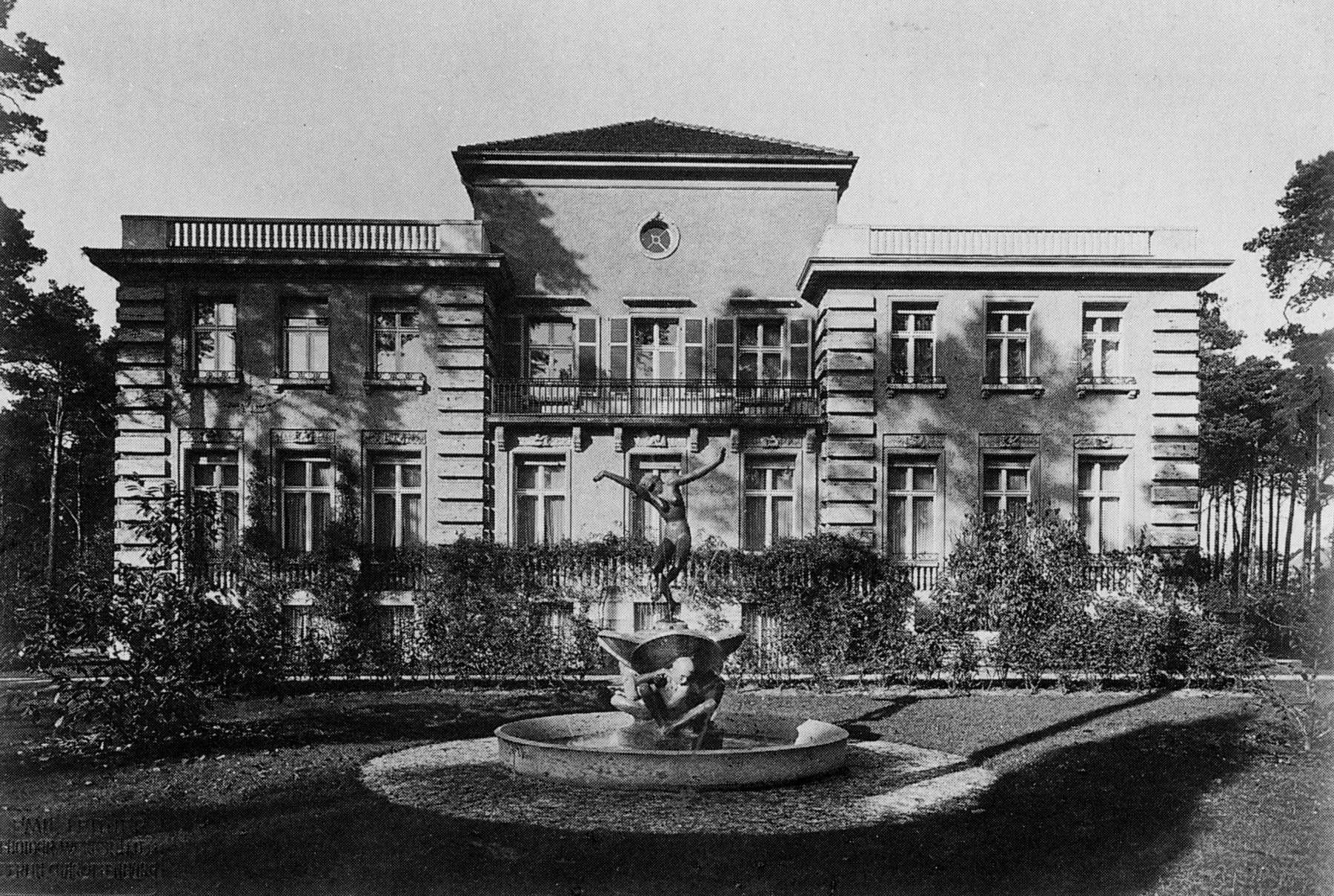
The Dancers‘ Fountain was commissioned by Heinrich Stahl (1868-1942),who lived in Berlin and worked for the internationally renowned Victoria insurance company. During his many years as director and shareholder of Victoria, Stahl achieved great wealth, which was also reflected in his representative villa in Berlin-Dahlem (Im Dol 32). Stahl was also a passionate art collector who owned a large collection of French Impressionists, as well as paintings by Lovis Corinth, Lesser Ury and Max Slevogt. He had a special friendship with the painter Max Liebermann, who painted a portrait of him in 1925 (Fig. 5). A letter from the same year has been preserved in Kolbe’s estate in which Stahl, referring to the fountain, described himself as: […] the happy owner of a marvellous creation by your hand […]’. As can be seen in historical photographs, the fountain was placed in a central position in the garden in front of Villa Stahl (Fig. 6).
1930s to 1940s
After the National Socialists came to power in 1933, Stahl, as a Jewish German, was no longer allowed to work in the domestic business under National Socialist legislation, so he was exclusively in charge of various foreign departments of the insurance company. He retired in 1937 at the age of 69. Heinrich Stahl earned special merit as chairman of the Jewish community in Berlin. During his seven-year term from 1933 to 1940, he focused on social work, which he saw as the cornerstone of the Jewish community. This included founding and supporting children’s and retirement homes and homeless shelters, as well as assisting his congregants with formal matters related to forced emigration plans and their implementation.
After Stahl resigned from office at his own request in January 1940, he informed the Gestapo in writing a few days later that he would leave Germany as soon as he had completed his preparations for emigration. Despite paying the Reich flight tax in February 1940, the Stahl couple were unable to emigrate to Belgium to join their son Bruno. The Gestapo blocked and prevented their departure. A year later, in January 1941, Stahl was ultimately forced to sell his villa and property. The property was sold to the Bulgarian Consul, Theodor Dimanow, at a unit value of 162,000 Reichsmark, based on the 1938 Decree on the Use of Jewish Property. The attachment to the purchase contract shows that ‚Prof. Kolbe’s fountain‘ was also sold.
After selling their house, the Stahl couple initially lived in a smaller apartment nearby, before moving into a communal apartment in Bozener Straße in Berlin Schöneberg on 4 June 1942. On 11 June 1942, both were taken to the collection camp on Große Hamburger Straße, from where they were deported to the Theresienstadt concentration camp. Heinrich Stahl died of pneumonia on 4 November 1942 as a result of the conditions in the camp. His wife Jenny survived the Holocaust and was able to emigrate from Sweden to the USA in 1950.
1950s to 1960s
The new owner of Villa Stahl was able to leave Berlin shortly after the end of the war: Theodor Dimanow settled in fascist Spain and took the Fountain Dancer with him to Madrid, where he installed her in his garden. The fountain basin with the supporting figures, however, remained in front of the villa, which was used as an emergency shelter after the end of the war.
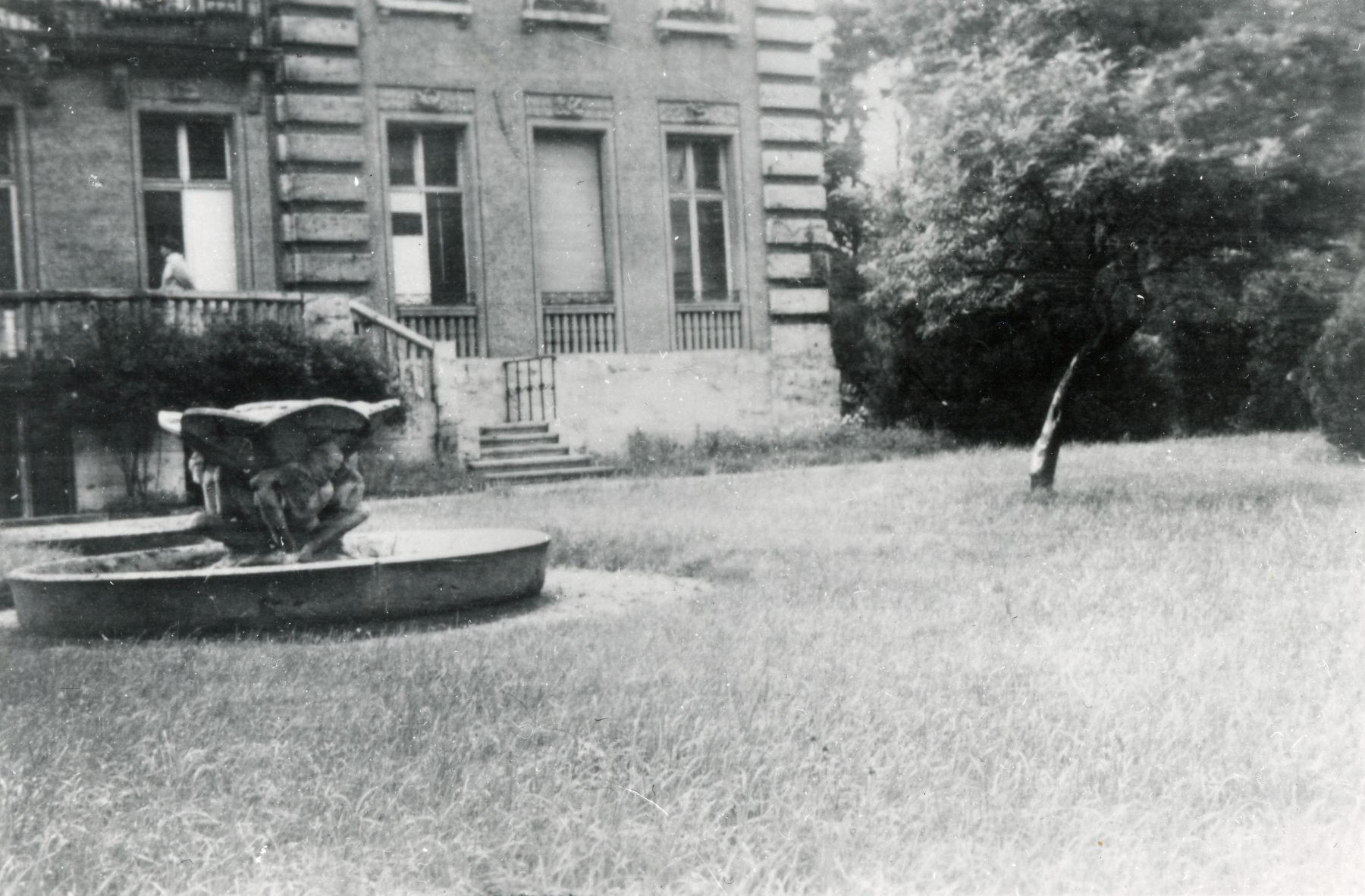
On 10 June 1950, Bruno Stahl and his mother Jenny Stahl filed a claim for the restitution of the property Im Dol 32 against Theodor Dimanow with the Berlin Restitution Office. For over three years they argued about the actual purchase price paid for the land and the villa. While Stahl’s heirs based their claim on the official purchase price, which was far too low, Dimanow claimed that he had paid Stahl more than four times as much, partly in cash, outside of the contract and as part of a so-called gentleman’s agreement. As for the fountain, he kept the heirs in the dark about the fact that the Fountain Dancer was still in his possession in Spain. In May 1953, both parties reached a settlement before the Berlin District Court, which provided for a payment of just 2000 US dollars from Theodor Dimanow to the Stahl family. In return, the heirs waived the return of the property and all related claims. It was only when Villa Stahl was demolished in the mid-1960s, as part of a small-scale new development with flat pavilions, that the fountain basin was dismantled and relocated. (Fig. 7).
1970s
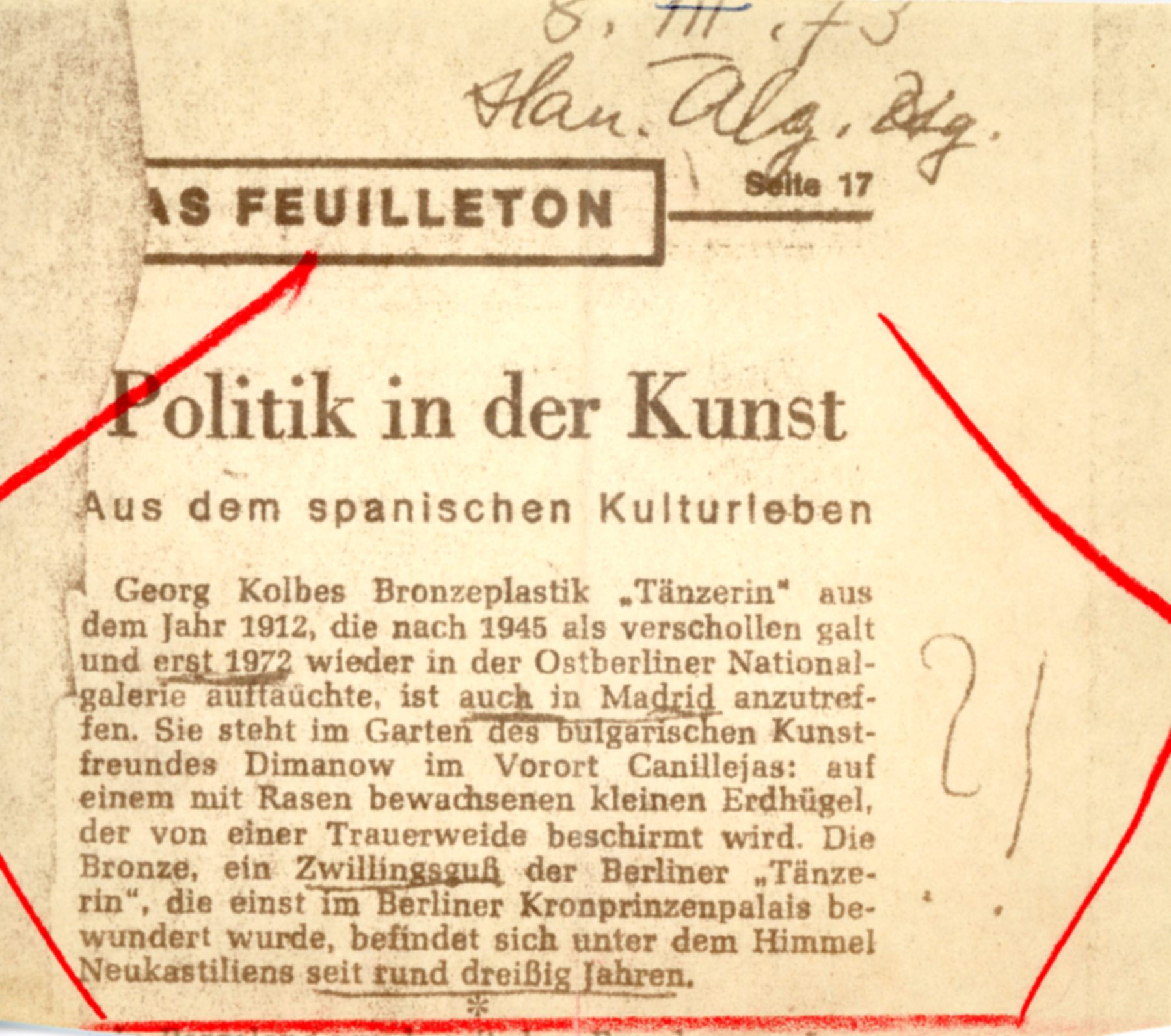
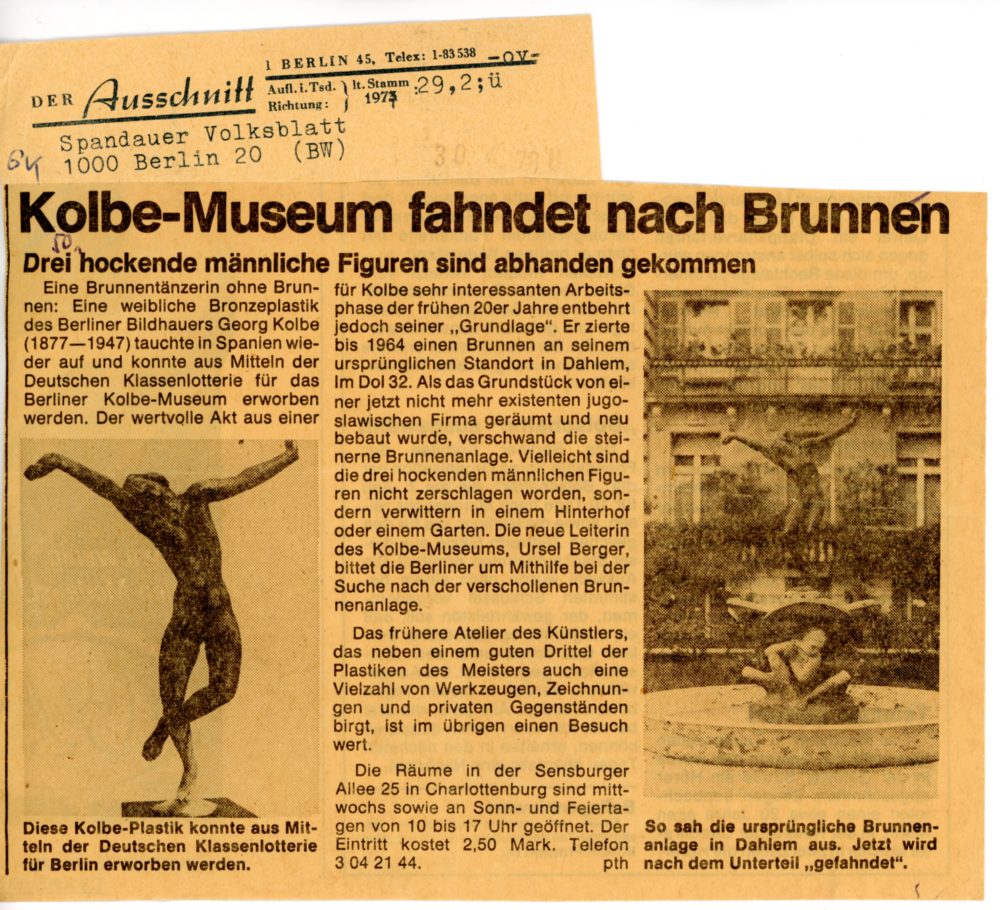
In the mid-1970s, the Dancers‘ Fountain was mentioned in a short report in the Hannoversche Allgemeine – she had surprisingly been discovered in Madrid. The article incorrectly referred to her as a „twin cast“ of Kolbe’s famous Dancer (Fig. 8). The then director of the Georg Kolbe Museum, Kolbe’s granddaughter Maria von Tiesenhausen, subsequently contacted Theodor Dimanow in Spain, who was mentioned in the article, in order to acquire the dancer for the museum. In 1975, Theodor Dimanow died whilst negotiations regarding a sale price were still ongoing. Two years later, Tiesenhausen finally reached an agreement with his descendants on a purchase price of 120,000 German marks, which was raised with the support of the German Class Lottery. After more than 30 years, the Dancers‘ Fountain returned to Berlin in January 1978 and was unveiled at the Georg Kolbe Museum shortly afterwards. The new director, Ursel Berger, who ran the Georg Kolbe Museum from 1978 to 2012, tried to trace Heinrich Stahl’s fate further. She interviewed former neighbours of the Stahl family, contacted a descendant in the United States, and asked Dimanow’s heirs for detailed information about the purchase and transport of the Dancers‘ Fountain to Spain.
In April 1978, the museum published a search notice in the Berlin press (Fig. 9). A resident of a retirement home in Berlin-Zehlendorf, Beerenstraße, then contacted the museum and stated that she could see the basin in the courtyard from her room. The following year, the Gehag building company, which presumably owned the property Im Dol 32 at one time or another, gave the Georg Kolbe Museum the dismantled fountain basin with the supporting figures. Finally, in autumn 1979, both parts – the bronze Fountain Dancer, which had returned from Spain and the base of the fountain – were reassembled in the garden of the Georg Kolbe Museum.
2000s to 2020s
In the early 2000s, further discussions took place between the Georg Kolbe Museum and Werner Stahl, the grandson of Heinrich Stahl, who subsequently agreed, on behalf of the family, to relinquish the fountain. The family requested that exhibition documentation make appropriate reference to the provenance of the bronze and the fate of Heinrich Stahl. As part of the research and exhibition project „The Fountain,“ the museum has been investigating and historically contextualizing the Dancers‘ Fountain since 2024. Subsequently, the museum initiated a dialogue with Stahl’s descendants to clarify the restitution issue and, based on this, to jointly develop new forms of remembrance. The fountain is indisputably cultural property confiscated as a result of Nazi persecution. The Georg Kolbe Museum draws conclusions from this regarding its ongoing handling of the object, commits to the Washington Principles, and has sought a just and fair solution with Heinrich Stahl’s descendants. Following legal clarifications, it has now been established that, in the early 2000s, Werner Stahl did not declare the relinquishment of the Dancers’ Fountain on behalf of the entire Stahl family. On this basis, the Georg Kolbe Museum returned the work to the community of heirs.